


Strengthen and Stretch: It’s what the Glutes and Piriformis Need
52 CommentsWhen most people picture running, they think “Chariots of Fire.” They see long, forward strides (and maybe a pretty cool soundtrack). In reality, a long distance runner’s main thrust happens behind his or her body.
Distance running performed properly is a pushing motion from when the mid-foot strikes the ground. This pushing contributes to the tightness and soreness that can affect the gluteal complex and piriformis muscle. The piriformis muscle lies underneath the gluteus muscle, or buttock. When your glutes and piriformis are tight and fatigued they can cause you to have a sore lower back and hamstrings, poor balance, and even shooting nerve pain down your leg due to sciatica.
(Your sciatic nerve shoots through your piriformis. When inflamed, the piriformis compresses this nerve causing the pain.)
Stretching and strengthening these muscles will help you run more efficiently and avoid injury. This post will touch on strengthening but will mainly cover stretching and recovery of tight and fatigued glutes and piriformis.
So what are the glutes and piriformis? The “glutes” are 3 separate muscles: gluteus maximus, gluteus medius, and gluteus minimus.
- The gluteus maximus is one of the strongest muscles in the human body and is one of the primary movers in running. It gives the runner that excellent “push.” This reason is why most running backs in the NFL and Olympic sprinters have large, round butts.
- The gluteus medius is a pelvic dynamic stabilizer, which means that it holds the runner’s pelvis in a neutral place when the runner is on one foot and lifting the other foot to stride. This muscle can become very tight particularly in a female runner due to her wider pelvis.
- The gluteus minimus and piriformis primarily laterally (outwardly) rotate flexed thighs. Abduction of the flexed thigh is important in running because it shifts the body weight to the opposite side of the foot being lifted, which keeps you from falling while striding.
STRENGTHENING
There are many ways to strengthen the glutes and piriformis that are easy to implement at home, even while watching television. Band walking and bridging are two examples.
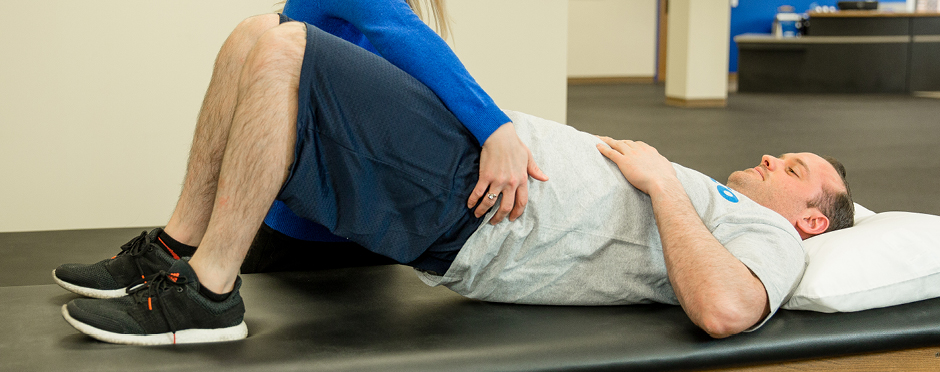
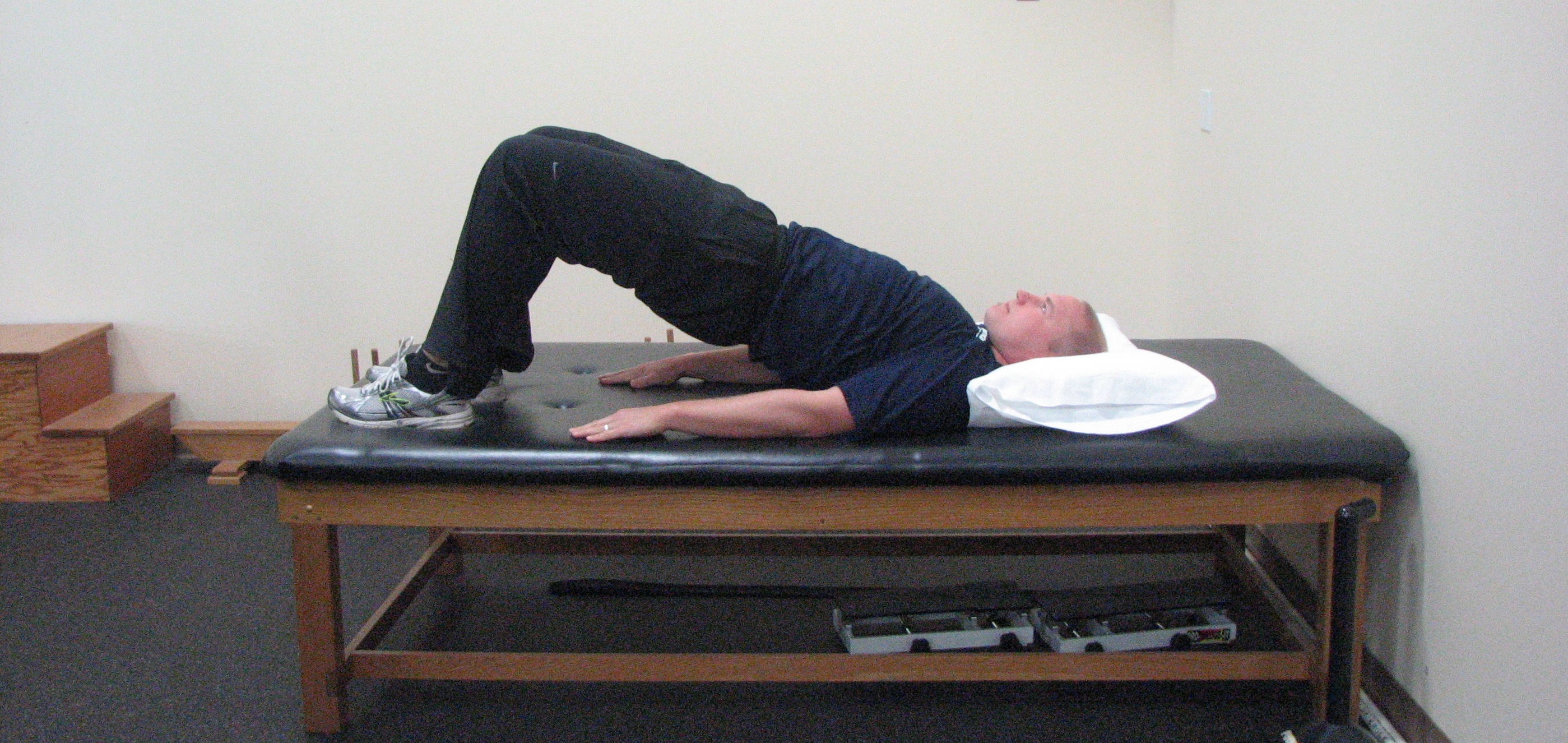
Bridging
- Begin this exercise while lying on your back with both knees bent at about a 45-degree angle and both feet flat on the floor.
- Let your arms rest at your sides.
- Slowly lift the hips by pushing on the floor with your feet until your knee, hip, and shoulder are a straight line.
- Repeat for 12 reps.
Lateral band walks
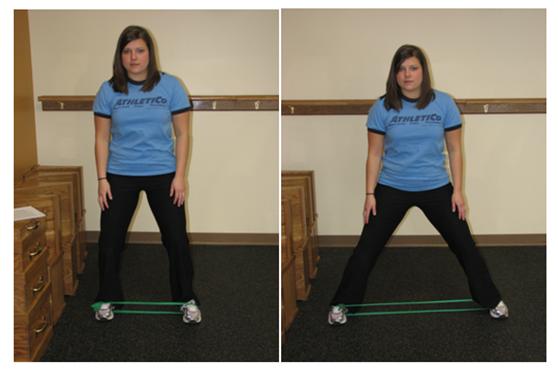
- Put resistance band on above each ankle.
- Separate feet slightly as you get into a 45-degree angle squat with your abs tucked (feel like you are trying to touch your belly button to your backbone).
- Step laterally.
- Keeping your shoulders even, bring other foot in towards the lead leg to finish your step.
- Repeat in the same direction for the length of the room.
- Return to the other side of the room facing the same direction.
STRETCHING
In my opinion, the main glute and piriformis problem is lack of stretching and recovery. I cannot emphasize how important they are to keep you running! Most people find stretching and recovery dull and time consuming. Nothing could be further from the truth! They will keep your body fresh and injury-free. How exciting and freeing up of your time could that be? Now I will climb off my soapbox and tell you what you can do to be fresh, fabulous, and pain-free with two of my favorite stretches.
Self-myofascial release with a tennis ball
- Sit down on the floor with a tennis ball under your left buttock.
- Cross your legs and place your left foot on the top of your right knee.
- Lean to the left, toward the outside.
- Roll around until you find a tight spot. You will know it is the tight spot because it will hurt a bit.
- Sit on the tight spot for 20-30 seconds. It will hurt a bit, hang in there!
- Keep on rolling around, finding tight spots, and blast them with the tennis ball!
Doin’ the Pigeon (not just for Burt anymore!)
- Sit down on a yoga mat or towel.
- Bring one knee forward up to the edge of the towel/mat
- Stretch the other leg back behind you.
- Align the foot of the bent leg with your knee (they should be perpendicular to the leg stretched behind you)
- Lean forward if you can.
RECOVERY
These are the two absolutely easiest things to do! If anyone gives you a hard time about these activities, tell them they are important for endurance training.
Sit on a bag of frozen vegetables
- Buy a bag of peas, carrots, or corn at the grocery store.
- Sit on them for 10 to 20 minutes
- Be sure to write on the bag “don’t eat.”
- Put the vegetables back in the freezer.
Relax on the couch!
- Tell others to wait on you; you are doing important running things!
- Read a book or watch TV.
Following these easy suggestions will keep you having fun and running far into your running career. See you on the path!


52 Comments
Harry Tichnor
Thanks for the information.
Ally Lofgren
Harry, you are very welcome!
Kris
I can attest to the importance of stretching the hams and glutes. I had noticed a lot of tightness and have really been focused on my stretching. It has really made a difference. Thanks for confirming that I have been doing the right stretches. I look forward to trying the strengthening tips!
Kathy Voboril
I use horseback riding to counteract the muscle imbalance caused by running. Riding strengthens the inside leg muscles because you have to grip the horse. Try it, it’s fun.
Ally
Great Suggestion Kathy! Thanks for the input.
Ned Moore
~ “Most people find stretching and recovery dull and time consuming.” Stop reading my mind, lol!!
~ These are excellent stretching routines.
~ Riding a bike and wall squats with a ball are both excellent for strengthening and stabilizing runners knees.
dave
your advice about glutes gave me the answer to my leg and pelvic problem. If only I had looked behind sooner. So grateful ~ MANY THANKS.
Celia
This has helped me a lot! I have experienced so much lower back and gluteal pain. I literally get knotted up so tight. The lateral band walks hit the spots! Thank you!
Karl Bedingfield
Great advice.
The last two weeks I have experienced discomfort behind the knee down to the inside of my right ankle. The strange thing was, when I explored that area there was no pain when I prodded. But since I used a tennis ball on my right glute things have improved.
Is this a fluke or was it deferred pain from the glute?
Thank you
rhonda duke
Thanks . I have pain in my glutes and didn’t know how to stretch it
lauri e
This article totally hits home. I experienced severe coccydynia after having my second child. Finally figured out I have extremely tight gluteus medius. It is painful to the touch. If I don’t roll it and stretch it daily I experience coccyx pain, sciatica pain and severe shooting pain down the sides of my hips. I used to be the athlete who could recover from anything without much effort. No longer. I’m assuming it is due to hips widening and muscle imbalances. argh! Thanks for the great article.
Joshua
I recently had a partial meniscectomy I’m 5 weeks post op I was feeling fine and everything but yesterday I had like a numbness/tingling that goes from under my glute to about mid thigh on my non operated leg my glute feels sore and was wondering if this would help I’m not in pain but it’s annoying
Emma
Looking for help…
I wonder if you could give me your opinion on whether you think I may have piriformis syndrome. I am at my wits end and really don’t know what to do or who to turn to next. 5 months ago I developed severe pain in my (what I thought) was my hamstrings. I initially thought I had torn both of them as they were so bad. I couldn’t walk or sleep and had gone from training 6 days a week for the last 25 years, to now hardly being able to walk to my car. I have had 2 MRI scans, 1 Fluroscopy, I have seen 3 different physiotherapists, 1 Podiatrists, 1 Osteopath and an Acupuncturist, all of whom can’t seem to diagnose my problem. All of my scans have come back clear. I’ve tried resting, icing, stretching, yoga etc and have just started to do some light training. I’ve had little to no improvement. And after trying to run for 1 mile this morning, feel worse.
I feel completely lost and disheartened with the whole thing, and just don’t know what to do. Should I just train through the pain and hope it will go away? Should I rest for another 5 months? I feel like my Consultant thinks I’m being a nuisance and i’ve spent all of my savings on pointless physio. No one has ever mentioned that I may have damaged my piriformis, but after reading this article, i feel that this may be the case. I have patches of sciatica down my legs and I can only really sit down for 15 minutes before the pain becomes unbearable.
I am guilty of having overtrained this year, with minimal stretching. I do a lot of cross training – running, cycling, crossfit, badminton. But no matter how much I stretch now, the pain just never improves. I haven’t tried the tennis ball or resistance band exercise which I will begin this evening.
I guess I’m just looking for some advice or assurance from anyone with similar issues as I just don’t know what to do….
Mark Palace
Thank you very much for these wonderful tips!
olive
i have tight glutes and because of this my hamstrings are painful, but i was wondering would this be causing the pain i get in my knee. i sometimes get a dart of a pain when i have been sitting and get up to go down stairs or when im getting out of the car, it also hurts when i try to straighten my leg..any suggestions..
raheim
How much does the recovery time take
Victor
Will cycling help or hamper recovery?
mika nessuno
I am very discouraged because I haven’t been able to run in ONE YEAR! I have a combination of piriformis and bursitis on my left hip/leg. I did go to see a few PT and did some stretching but I saw absolutely no improvement. IN fact, not it starts to hurt even after a 2 mile walk (not run).
One thing that I can say is that I have not been very diligent with stretching. Is it really very important that I do strengthening and stretching every day? Are there other options besides stretching? I find it hard to believe that stretching is the only way to cure this issue.
Thankyou,
Mika
Filomena
Thank you so much. I did my first half marathon and my glutes were hurting a few days later. I did not stretch. Forgot with the excitement of the finish. Your tips have helped me so much.
M Grayson
A heads up, I suffer from Sciatica pain on the right side of my body, everything hurt for the longest time, stretching out the hamstrings was most beneficial to my recovery. After those muscles weren’t super-tense anymore, I started regaining range of motion and the ability to walk without a limp or massive pain. Some days are still rough, but since I started doing exercises (a 10 min. abs fat burner workout and a 10 min. boot camp abs workout) those actually helped the most. After just 3 days of high-intensity workouts, the pain is virtually gone at all times. I’m functioning normally and able to fast-walk for a mile without any pain during or after.
M Pearson
I recently had to forego doing Boston due to what I now know as a piriform muscle issue. It came on fairly suddenly – soreness in my left/lower left Glutes. Never had this before. I stopped running and did my best to stretch it out and finally (after lttle success) and 3 weeks of all this – visited a PT and started rolling on it with a softball… painful, yes! But within 2 weeks I had it pretty much licked. Just started running again (started Boston Marathon Monday) – am also doing the streches and strengthening that is also recommended on this web site.
Looks like I’ll be coming to this web site more often! Thanks for further confimation.
Guy
Thank you. I have piriformis syndrome on both sides and it is extremely painful. The tennis ball idea has really helped along with stretching 3-4 times per day. Without stretching, this will only get worse. Two years ago, had the same issue and it led to numbness down both legs. Chiro adjustments also helped. You need to start early with the stretching, as soon as you start getting the pain and avoid inclines or declines.
Claire storey
Thanks for this tried your stretches it I have PS which seems to have calmed a little on my right side, my concern is no matter which stretches I try I can’t seem to find a stretch point on this side, my left side I know where my stretch point is my right bad side I can’t feel absolutely nothing in terms of stretching or limits of flexibility – any suggestions anyone please?
Rick
Post 16, Emma, I hope you’ve found some relief, keep in mind these types of injuries take time, I am currently entering my 7th month of what I have determined to be Gluteous Medius tendonosis. I suspect that early on I made things worse by the types of strecthes I did at the time, never thinking about the strengthening component. I am now taking a more balanced approach and hopefully things will start to improve. Just wanted to say “Hang in There”!
Dan Zalinsky
Although not formally diagnosed, I believe I have piriformis syndrome in both legs. Along with increasing the number of weekly sports conditioning classes, I kicked it up a bit this summery with some intense track work outs. I would never cool down properly and ignored the early signs something was wrong. Do we ever learn? Nothing bothers my sciatica more than running and sitting. I have now started stretching and rolling three times a day as well as ibuprofen and ice. My flexibility is coming back but cannot run with tightness and dull pain…and sometimes weakness in my hamstrings. Hope to be healed soon.
Jeff Gray
I have had lower rib and back pain for several years with no relief, I have noticed that when my glutes and hamstrings get stretched that I get much relief, would it make sense that tight glutes could effect my lower back and ribs that much, i have been to countless chiropractors and had Mri completed, could it be as simple as tightness??
David Alberti
On 09/11/14 I had Lumbar Spinal Stenosis surgery of the L5 Sciatic nerve coming out of the vertebrae.. The pain prior to surgery was at a 3 level in the left glutes almost constantly on the pain scale from 0-10. After surgery, I am in the worst pain ever.. The left foot is numb and the pain in the left glutes is at a 4-5 level constantly and it spikes up to a 9-10. I have been through physical therapy and they have tried different meds on me with limited relief.. I have tried all the stretching exercises.. I have the balls, straps, you name it.. TENS therapy does nothing.. The only thing that even gives a little bit of relief is morphine based injected drugs.. Think twice before getting any type of Stenosis surgery.
Paul
I’ve suffered with it for ages..but over the past few days i’ve been doing high Intensity stuff…mainly using a square box and quickly putting feet up and down…its worked wonders..no pain…will see how it goes over the coming weeks..give it a try!!
Amy
I haven’t been diagnosed with piriformis but I’m positive that’s what I’m suffering with. It’s incredibly painful and I’m having difficulty walking. It’s put a stop to any running, and even walking proves difficult sometimes.
Thanks so much for the detailed article. It’s reassuring to know there is something I can do at home to deal with it.
One question though. How often should I do the strengthening exercises? Everyday or every other day?
Jim
How often should I do these exercises?
EB
Gluteus minimums actually plays a role in medial rotation of the thigh among other things (not lateral as stated here). Minimus can refer pain down the lateral legs as well, in addition to the posterior compartment of the thigh. It is a little bugger when it gets unhappy.
Laura
I think these strengthening moves will be of great help but how often should I do them?
Diane
I have scoliosis. From birth. 6 yrs ago had my left knee totally replaced which left my right side half inch shorter and my scoliosis. Made me shorter on the right side before the left knee replacement. And 3 months ago I had the fight knee totally replaced and I pushed myself with exercises to get back on my feet but 2 months ago I got a Lumpur knot in my piriformis muscle from what I have read What can I do to get rid of the knot which is the size of a dime. Or what should I not do so I don’t make it worse. Please advise
Athletico
Thank you for reaching out regarding your history and request for information. Total joints do have the ability to create leg length discrepancies, combined with the fact you have a long history of scoliosis the cause of your symptoms are likely multifactorial. Being that you have been living with scoliosis since birth it’s more likely this symptom of gluteal pain could be driven by altered walking pattern from your total joints or limited mobility in your ankles, hips, lumbar or thoracic spine. Leg length discrepancies are not uncommon in the general population and need to be evaluated on an individual basis to determine if they are a primary driver of your pain. In my experience piriformis pain can be addressed by addressing movement restrictions in joints within, above and/or below the lumbar spine. My recommendation to you is to consult with your primary care physician regarding the development of your symptoms or schedule a complimentary injury screen with an Athletico physical therapist who can review your history and movement patterns and make a recommendation based on your individual findings.
Omar jauregui
So is this also a cure for piriformis syndrome?
Bruce Wade
It looks like I’m now in a long line of chronic piriformis suffers. Even though I have stretched 2x a day for yrs I injuried my glut because I did a dbl workout about 2 months ago. I had been working out 6 days a wk and now I am a reluctant couch potato. If stretching were the answer I would have been cured wks ago, Some days I think I’m stretching too much….even though I have tried easing off from my stretching but with no success.
I do have a suggestion for those readers who have been sitting on tennis balls for some relief.
I have taken a very large sock (i.e. long sock) and filled it up with about 5-6 tennis balls and then
tied off the sock so the tennis balls cannot escape. I then roll against the sock against a wall as it is pressed against my piriformis or back. You can work on a larger area of the affected muscle that way and you can control the pain that is created from this exercise by how much you are pressing against it.
I am also discouraged like so many others but I will continue to experiment with trial and error and hopefully find relief very soon.
Bruce
Leslie MacMillan
These are all excellent stretches and exercises! They’re exactly what my physiotherapist gave me and doing them diligently 3 times a day paid off. I still do them even though I’m better. As we age we need to!
Corinne Perry
I was diagnosed about 4 years ago with piriformis syndrome, left side then. I also have lower back and sciatica problems. Physical therapy cleared up original problem, but it still appears periodically, sometimes left, sometimes right side. When I get lax about stretching and strength exercises, I am more prone to develop pain. After reading this article and comments from others with these problems, I am making a commitment to faithfully do all I can to PREVENT problem to the extent I can. I know there is no cure, but it is encouraging to know there are ways to help. I found the article and the exercises shown to be very helpful. I will see if you have a facility in my area for possible further professional evaluation and treatment.
Bryan Hicks
I have had either a piriformis or gluteus medius issue for almost 5 years now, and it is very frustrating. I know it could be worse, much worse, so I really do hesitate to complain, I just want to figure this out. I stretch, I back off running, I rest, I lower mileage, I work on running form. I feel better and increase my mileage. I hit about 22 miles a week and the injury returns. If I rest up and build up to about 15 miles a week that seems to be about my happy medium, but I would prefer to do 30 a week (and unfortunately I think I may have to rest a little longer this time). Running is the most satisfying workout, with hiking being a close second, and keeps me at my ideal weight. Hiking is less pounding and probably more sustainable, but hiking is not always an option. I am afraid this will become chronic if I don’t figure it out soon, if it hasn’t already. PT’s don’t seem to help. Argh. I am 47 and fit, and want to be fit at 50, 60, 70 and beyond. Just want to figure this out.
Morgane Evans
Really good information! Doing the pigeon looks impossible to me! I’ve had a stroke with open heart surgery shortly after!! So I’m extremely tight in my left hip all the way down to my toes!!
Rooni Tunes
Thank you for these tips! “Doin’ the Pigeon” is VERY helpful. Hamstring stretches will be beneficial, too. I appreciate the help very much to decrease the tightness and soreness of the glutes and piriformis, I’m not a runner, but I think this condition got exacerbated from an uneven gait due to wearing an ortho shoe following the fracture of my big toe. Ah well, the body is good at reminding us about the importance of stretching and strengthening!
Meg
Thanks. I tried the stretches and they work. I feel like crying I am so happy.
Sandra Buss
I am 70 years old and had a very bad fall backwards down steps after fainting, hitting my buttocks really bad. From time to time it flairs like it did last week. I iced, stretched and walked turning my feet inward with large stride as shown by my doctor. Why does it continue to flair? I am very active. I don’t sit all day as I volunteer a lot or work in my garden. I also cook every day for my husband and myself. Need some help here but please remember I don’t run and extreme exercise is just too hard. I am very arthritic.
Steve bromeo
I went to my doctor with a complaint of low back pain ,pain in my left glute which ran down my leg behind knee to my foot. I told Dr. I had poor balance . After a few more tests I was diagnosed with multiple sclerosis.
Hal
I had my L5 and S1 fused 5 weeks ago, ALIF and PLI F procedure. Before surgery my pain levels could jump from 3-8, primarily down the left leg. I am happy to say I have none of the sporadic sharp, dull, throbbing , constant pain I had before. I have moderate “glute” aches which I now try to stretch out daily however the throbbing continues. I can walk 1/2 mile with ease. I just found the “Pigeon” stretch and wow, what a difference. Smiling again! I would believe my symptoms will subside with continuing stretching and future PT. Muscle apathy sucks—I waited almost 4 months for surgery—now 61 and ready to be pain free. By the way—I was injured by a 19 year old Teen with his ear buds in and watching his phone—getting smacked in stopped freeway traffic.
Andrew Lewis
Oh my days
Had glute pain for years
Totally hampered my life
Recently diagnosed as piriform is syndrome by UK NHS
Been stretching zapping with tennis ball.
Still didn’t feel normal.
Adding that lateral band walking though made the difference!!
Thank You!!😁👍🤸🤓
Lindsey h
Iveskipped on stretching my quads for a while!! But I’ve been stretching my hamstring and calves whenever I could cuz I now have my right hamstring and calves a little sore and really tight. I followed these stretches and quad stretches and got a better!!!!
Samantha Stockdale
I am so grateful for your advise, thank you. I will continue with these stretches in the hope that I can return to running.
Mark Conklin
Awesome STRETCHES, will keep doing these STRETCHES thank you so much.
Lynette
My dog is not a ball player, so I don’t have a tennis ball, so I just put an orange in the freezer, inspired by the suggestion about sitting on a bag of frozen veggies! I had learned 18 years ago, at a yoga class, how to “open your hip, with an exercise very similar to yours with the tennis ball, to rid me, from similar pain, on long car rides. So glad to find it again! Haven’t slept for a week, because of the discomfort & pain, just from rolling over in bed. Since we are going through the corona virus, I was going to call my doctor, but finding your article, has given me hope to be able to remediate the problem on my own, without leaving the house. Thanks so very much!
Jenny Steinlage
Do you have a photo of using the tennis ball to release the piriformis?? Would love to share this with a coworker who is suffering from piriformis pain, but a photo or video would be super helpful!!
Tomi Stone
This was really helpful I appreciate a lot thanks heaps!!